
India's Polar Satellite Launch vehicle-C16 rocket on Wednesday successfully launched into orbit the latest remote sensing satellite Resourcesat-2 that would study and help manage natural resources along with two nano satellites.
State-run Hindustan Aeronautics Limited has won a bid under which it will receive technology from the Indian Space Research Organisation for the end-to-end commercial production of the Small Satellite Launch Vehicle (SSLV), a first for the industry as India seeks to become a global hub for small satellite manufacturing and launches.
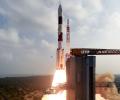
The Indian Space Research Organisation (ISRO) is all set to make its maiden commercial launch of 36 broadband communication satellites on board the space agency's heaviest rocket LVM3-M2, the countdown for which began early on Saturday at Sriharikota spaceport in Andhra Pradesh.
For the first time in the history of Indian space research, a satellite developed by a university in India will be launched by the Indian Space Research Institute (Isro) during the next flight of the Polar Satellite Launch Vehicle (PSLV). Tentatively scheduled for launch in March-April this year, the vehicle will carry a small remote-sensing satellite completely developed and fabricated by Chennai-based Anna University, sources in Isro said.
The GSAT-12 communication satellite, launched onboard PSLV-C17, has been successfully placed in geosynchronous orbit with a perigee of 35,684 km, apogee of 35,715 km and an orbital inclination of 0.17 deg with respect to the equatorial plane.
The placing of four satellites into orbit on October 12, 2011 is yet another milestone in the glorious career of Indian Space Research Organisation's trusted Polar Satellite Launch Vehicle.
The Indian government has approved the construction of a third launch pad at Sriharikota, capable of sending heavier spacecraft into orbit. This new facility will support India's ambitious space program, including the Gaganyaan human spaceflight mission and a lunar landing. The launch pad will be built at the Satish Dhawan Space Centre and is expected to be operational within four years.

The move follows a quiet visit by National Security Advisor Ajit Kumar Doval to the Vikram Sarabhai Space Centre in Thiruvananthapuram.
The placing of four satellites into orbit on October 12, 2011 is yet another milestone in the glorious career of Indian Space Research Organisation's trusted Polar Satellite Launch Vehicle.
A S Kiran Kumar, chief of ISRO, said the mission was unsuccessful because the satellite housed within the heat sink could not be injected.

The polar satellite launch vehicle-C42 launch vehicle carrying the two satellites blasted off from the first launchpad at the Satish Dhawan Space Centre at 10.08 pm.
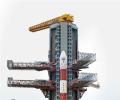
A 48-hour countdown began on Monday for the launch of record 20 satellites, including India's latest earth observation Cartosat-2 Series Satellite, onboard PSLV C-34 from Sriharikota on June 22.
India's Polar Satellite Launch Vehicle on Wednesday successfully sent into orbit four satellites, including the Indo-French tropical weather satellite Megha-Tropiques.
The 51-hour countdown for India's landmark 100th space mission began on Friday with Indian Space Research Organisation's old warhorse Polar Satellite Launch Vehicle rocket all set to soar into space on September 9 with two foreign satellites from the spaceport of Sriharikota in Andhra Pradesh.

AzaadiSAT had around 75 small payloads developed by schoolgirls of 75 rural schools.

The RISAT-2B would replace the RISAT-2, which has been actively used by India to monitor activities in camps across the border in Pakistan to thwart infiltration bids by terrorists.
The Polar Satellite Launch Vehicle PSLV-C15 carrying five payloads, including India's remote sensing satellite Cartosat-2B, successfully lifted off from the spaceport in Sriharikota on Monday.

The primary satellite TeLEOS-2 is a synthetic aperture radar satellite developed under partnership between Defence Science and Technology Agency (DSTA) representing the Government of Singapore and ST Engineering.
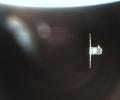
The Indian Space Research Organisation (ISRO) has successfully performed the docking of satellites as part of the Space Docking Experiment (SpaDeX). The docking was achieved after a series of maneuvers, including a trial attempt on January 12. The SpaDeX mission, launched on December 30, 2024, aims to demonstrate in-space docking technology using two small spacecraft. This technology is crucial for achieving complex mission objectives that require multiple rocket launches.

The ISRO is strengthening 'eye in the sky', which helped the Indian army carry out surgical strikes last year, with the launch.

The Indian space agency has already begun work on the third generation of the earth observation satellite -- the first of which will be ready by 2018 and boost the capability to generate digital maps.
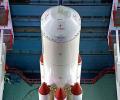
India on Friday successfully launched its latest communication satellite GSAT-12 onboard a powerful variant of homegrown Polar Satellite Launch Vehicle, PSLV-C17, from the spaceport in Sriharikota.

ISRO said the upper stage of the Polar Satellite Launch Vehicle - C37 (PSLV-C37) re-entered the earth's atmosphere on October 6, 2024 and the impact point was the North Atlantic Ocean.
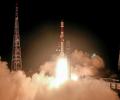
The two Space Docking Experiment (SpaDeX) satellites that the Indian Space Research Organisation is hoping to unite are at a distance of 1.5 km and will be brought much closer on January 11, the space agency said on Friday.

The two satellites that PSLV will release in the orbit will help the country's mapmakers and amateur radio operators.

On Sunday, July 30, 2023, the Indian Space Research Organisation successfully launched its proven Polar Satellite Launch Vehicle rocket carrying seven Singapore satellites from the Satish Dhawan Space Centre in Sriharikota and placed them into intended orbits.
Indian Space Research Organisation is using the most powerful configuration of its rocket Polar Satellite Launch Vehicle to launch a communication satellite from Sriharikota on July 15, as it braces for the nearly Rs 200 crore mission.
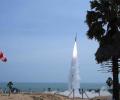
The fuel cost will come down if rockets are launched from Kulasekarapattinam as they will have a straight trajectory and need not have to avoid Sri Lanka, which is being done by rockets flown from Sriharikota.
India will join an elite group of nations with the launch of a new mission to test re-entry technology, which would be a forerunner to developing reusable vehicles like space shuttles.
ISRO will launch TechSAR, Israel's first synthetic aperture radar imaging satellite.
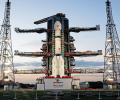
The imaging technology in Nisar can provide very high-resolution data on changes as small as one centimetre in size on the earth's surface.
The Indian Space Research Organisation on Wednesday successfully launched seven satellites in 1,200 seconds with the help of its most trusted Polar Satellite Launch Vehicle from the Sriharikota spaceport in Andhra Pradesh coast.The launch was carried out as per schedule at 11.51 am and ended at 12.06 pm.Vice President Hamid Ansari, who was present at the Satish Dhavan Space Centre, congratulated the scientists and technocrats over this splendid achievement for the nation.

Bharti Group-backed OneWeb on Monday said it has entered an arrangement with the commercial arm of ISRO, NewSpace India Limited (NSIL), to launch its satellite in India from 2022.

The earth observation satellite would provide real-time images of the country and also be able to quickly monitor natural disasters.
For carrying the 360-kg Italian satellite, meant for astronomical studies, Indian Space Department's commercial wing Antrix Corporation would receive a fee from the Italian space agency.
The PSLV-C8 rocket will make its first commercial launch with an Italian astronomical satellite on board.

Microsat-R, an imaging satellite, is meant for military purposes, but the ISRO did not give any details about it.

India's ambitious space mission to explore planet Mars would be launched on November 5 from the spaceport of Sriharikota, ISRO announced on Tuesday.
Greet the scientists on achieving this major milestone!
